Two points to keep in mind
The absence of a warning does not establish the absence of exposure. A warning, by itself, does not establish an individual’s dose or show that an exposure caused illness.
Plastics, fuels, pesticides, and chemicals formed during cooking are part of modern life. Some exposure risks are well established. Others, including many questions about microplastics, remain under investigation.
This guide brings together publicly available information. Microplastics, plastic additives, fuel vapors, and pesticides are different exposure topics and should be evaluated separately.
California warnings do not mean California-only exposures
Proposition 65 is a California law requiring warnings about certain exposures to listed chemicals associated with cancer or reproductive harm. Exceptions and exposure thresholds apply; detecting a listed chemical does not automatically require a warning.
Similar products and materials may be used elsewhere in the United States and internationally. California acknowledges that some products sold outside the state carry its warnings because manufacturers distribute them with the same labeling.
Warning requirements vary by jurisdiction. Products, amounts, and exposure conditions can also vary, so exposures should not be assumed to be identical everywhere.
Sources: Proposition 65 FAQ · Warnings outside California
Presence, exposure, hazard, and risk
A substance or particle exists in a product or environment.
A person encounters it through a route such as breathing, swallowing, or skin contact.
Its ability to cause harm under particular conditions.
The likelihood of harm under the actual exposure conditions.
A warning generally does not tell us how much a person absorbed, how often exposure occurred, or for how long. It cannot establish the cause of an individual’s cancer.
Microplastics and nanoplastics
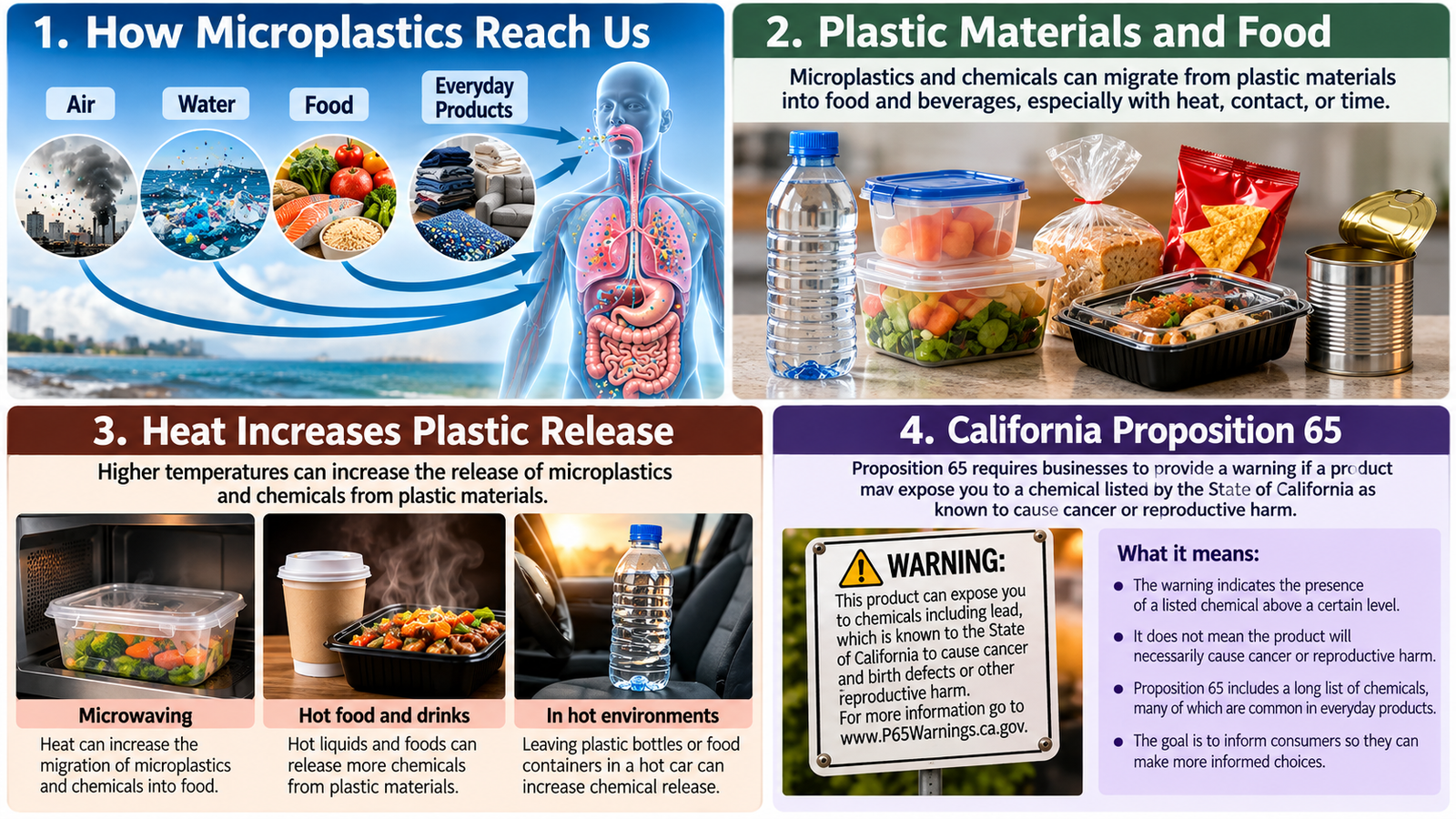 Microplastics are small plastic particles, generally described
as smaller than five millimeters. Nanoplastics are smaller
still. Definitions and measurement methods are not yet fully
standardized.
The FDA recognizes evidence that these particles can enter the food supply, primarily through environmental contamination. It also describes potential exposure through food and air.
According to the FDA, current evidence does not demonstrate that the levels detected in food pose a risk to human health. The agency identifies measurement limitations and continues monitoring research. This assessment does not settle every question about every route of exposure.
This guide does not present microplastics as a proven cause of cancer in humans or claim that all exposures are harmless.
Plastic additives are different from plastic particles
DEHP belongs to a family of chemicals called phthalates. It is used to make certain plastics flexible. California lists DEHP under Proposition 65 for cancer and reproductive harm.
DEHP can be present in some vinyl products and other materials. California explains that it can gradually leave certain products and accumulate in indoor dust and air.
A DEHP warning is not a measurement of microplastics and does not establish how much a particular person received.
Source: California: DEHP information
Gas stations: fuel, vapors, and engine exhaust
Gas station signs may combine fire-prevention instructions with chemical exposure warnings. The warning photographed for this guide concerns gasoline, vapors, and engine exhaust. These concerns are distinct from microplastics.
A photograph documents a posted warning. It does not measure contamination, establish a person’s exposure, or demonstrate that a location caused illness.
Source: California: Service Stations
Hotels, motels, and other lodging
Warnings may appear in hotels and motels. California explains that establishments differ and that many hotels may not produce exposures requiring a Proposition 65 warning. Official examples include tobacco smoke and chemicals in certain foods and beverages.
A motel sign reviewed for this guide identifies DEHP in plastic and vinyl items. This does not establish that all hotels contain the same materials or produce equivalent exposures.
Guests can ask management which substance a warning identifies and where exposure may occur.
Source: California: Hotels and Other Lodging Establishments (PDF)
Restaurant warnings also appear online
Warnings can appear in digital menus and ordering platforms. For example, a Panda Express menu on Uber Eats includes a Proposition 65 warning mentioning acrylamide in certain fried or baked foods and mercury in fish.
This describes a published notice, not an independent laboratory assessment. It does not mean every dish contains every substance named or identify the amount in a serving.
Example: Panda Express menu on Uber Eats
Acrylamide and the cancer evidence
Acrylamide can form when certain foods are cooked at high temperatures, particularly some starchy foods. Amounts vary with the food and preparation method.
The National Cancer Institute reports cancer-related effects in animal studies. Human epidemiological studies, however, have not found consistent evidence connecting dietary acrylamide exposure with any type of cancer.
A warning therefore does not justify stating that eating a particular meal causes cancer.
Source: National Cancer Institute: Acrylamide and Cancer Risk
An important update about coffee
Older signs may mention acrylamide in coffee. In 2019, California determined that chemicals created during normal coffee roasting and brewing do not pose a significant cancer risk requiring a Proposition 65 warning. Older signs may differ from current guidance.
Nurseries, plants, and pesticides
Nursery notices should be interpreted according to their exact wording. A warning may concern products sold, applications on the premises, or treatments associated with plants. Without the notice and supporting information, we cannot identify the substance, amount, or relevant exposure.
Glyphosate is an herbicide used to control unwanted plants. Its potential use in landscaping does not establish that every plant sold at a nursery was treated with it.
Questions to ask
- Which product was applied, and when?
- Does the warning concern the plants, premises, or products sold?
- What handling precautions or other instructions apply?
This guide does not attribute glyphosate use to a particular nursery without verifiable documentation.
Glyphosate: different assessments and ongoing review
In 2015, the International Agency for Research on Cancer classified glyphosate as probably carcinogenic to humans, Group 2A. This identifies a cancer hazard; it does not calculate the risk from a particular nursery visit.
The U.S. EPA reached a different conclusion in its 2017 assessment, describing glyphosate as not likely to be carcinogenic to humans. As of this page’s review date, EPA reports an updated human health and cancer assessment is underway, with completion anticipated in late 2026.
In 2022, a federal court vacated the human health portion of EPA’s interim decision, and EPA subsequently withdrew that decision. This regulatory history is not a finding that a particular exposure caused an individual’s cancer.
Differences between assessments should be considered with their dates, methods, and scope. They do not, by themselves, establish concealment or misconduct.
Sources: IARC: Glyphosate Q&A (PDF) · EPA: Glyphosate and regulatory history
Different agencies address different questions
- FDA oversees food safety within its jurisdiction and publishes information about food contaminants.
- EPA evaluates and regulates pesticides and other environmental exposures within its authority.
- OEHHA, within CalEPA, administers aspects of Proposition 65 and publishes information about warnings.
A permitted use, a hazard classification, and a warning requirement are different regulatory concepts. They should not automatically be interpreted as guarantees of zero risk or proof that every contact causes harm.
References: FDA · EPA · California Proposition 65
Practical steps for specific exposures
- Read the full warning and identify the substance and exposure route.
- Check official sources and whether the notice reflects current guidance.
- Ask hotel management about warnings and consider smoke-free lodging.
- To reduce contact with dust that may contain DEHP, wash hands before eating and clean surfaces with a damp cloth.
- Follow posted fuel-handling and safety instructions.
- Ask nurseries about treatments and applicable product instructions.
- To reduce acrylamide formation in some foods, avoid excessive browning or crisping.
These measures address particular exposures. They do not guarantee elimination of microplastics or prevention of cancer.
Sources: DEHP guidance · Hotel guidance (PDF) · Acrylamide information
Common questions
Does a warning mean a product is banned?
Not necessarily. Warning requirements and product prohibitions are different measures.
Does no warning mean no exposure?
No. Laws, disclosure requirements, and exposure conditions vary.
Can a warning establish what caused someone’s cancer?
No. A general warning cannot establish the cause of an individual’s illness.
Can these exposures occur outside California?
Yes, similar exposures can occur elsewhere. Substances, amounts, and conditions should not be assumed identical.
Should I change medical treatment because of this page?
Do not change treatment based on this guide. Discuss medications, testing, and medical devices with your treating team.
Educational & editorial notice
This page provides general educational information. It summarizes publicly available sources in original wording and links readers to the underlying documents.
It does not provide medical advice, diagnosis, treatment, or legal advice. It does not determine the safety of a particular product or establish the cause of an individual’s illness.
Agency statements reflect the scope and date of the cited sources. Scientific evidence, online menus, and regulatory decisions may change.
Photographed warnings are examples of observed notices, not laboratory analyses, inspections, or evidence of violations. Business references do not imply affiliation, sponsorship, or a conclusion that a business caused illness.
A warning alone does not establish a harmful dose, a legal violation, or a causal connection with cancer. This page does not allege fraud, concealment, or unlawful conduct by any identified business or institution.
Discuss personal health concerns with a qualified healthcare professional. Do not delay care, stop prescribed treatment, or avoid medically necessary procedures based on this page.
We aim to present accurate information. Readers may report possible errors through the website’s available contact channel, identifying the statement and providing a verifiable source for review.