Know the journey behind your food
A fresh-looking food can have a processing history you cannot see. The consumer deserves to know what was applied, what remains, and what evidence supports its use.
Food awareness begins before the ingredient list. It includes how crops are grown, how animals are raised, what happens after harvest, and which materials touch the food before it reaches the table.
Four questions worth asking
What was added? What is the actual exposure? Who evaluated it? What remains uncertain?
This guide follows that journey. Its purpose is to make treatments and exposure questions visible, and to help readers make practical choices grounded in evidence.
From shorter food journeys to longer supply chains
For comparison, consider a household preparing seasonal produce, legumes, and other basic foods from a relatively short supply chain, alongside a household relying heavily on packaged meals and products designed for extended storage. These are illustrative patterns, not descriptions of every family or every historical period.
| Stage | A shorter, simpler food journey | Questions in an industrial supply chain |
|---|---|---|
| Growing | Known grower and seasonal harvest. | Which pesticides were applied? Is soil or irrigation water contaminated? |
| After harvest | Preparation relatively soon after harvest. | Were fungicides, sanitizers, waxes, or other coatings applied? |
| Animal production | Direct knowledge of a farm's feeding and husbandry. | What are the feeding, antibiotic-use, and traceability practices? |
| Formulation | Meals prepared from basic ingredients. | What preservatives, emulsifiers, flavors, or other ingredients are used? |
| Packaging | Fewer storage and food-contact stages. | Which materials contact food, and under what heat and storage conditions? |
Some preservation methods and agricultural hazards are old; others have changed in scale or composition. This comparison identifies places to investigate rather than claiming that all past food was organic or uncontaminated.
Fresh appearance is not a complete processing history.
Sources: [1] WHO: Healthy diet · [9] WHO: Pesticide residues in food · [12] NIEHS: Endocrine disruptors · [14] WHO: Antibiotic use in healthy food-producing animals.
The invisible layer on fruits and vegetables
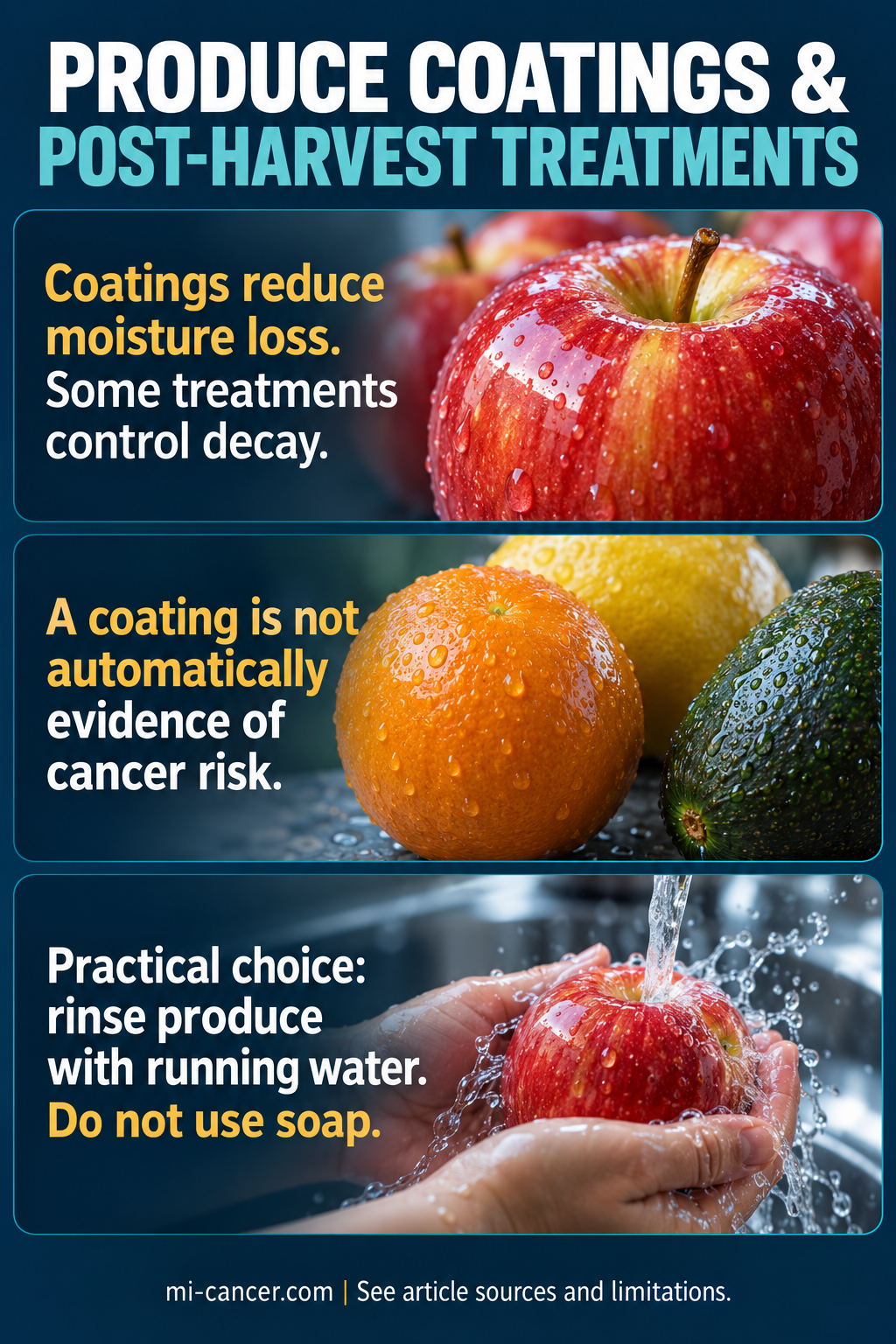
An edible coating is an added layer, even when it is difficult to see or taste. Waxes and lipid-based formulations can reduce moisture loss. Separate treatments may target fungi or microorganisms. A single fruit may therefore raise more than one ingredient question.
Public documentation for Apeel GRN 886 describes monoacylglycerides derived from grape seed. A different, early research project described cutin-like polyester barriers. Those are different records: an experimental polymer coating should not be used to identify the chemistry of every current product.
Sources: [5] FDA: GRN 886—Monoacylglycerides from grape seed · [22] Grand Challenges: Molecular camouflage—developing natural barrier coatings.
Ask for the actual formulation. “Plant-based,” “edible,” and “fresh” do not provide a complete ingredient specification. Ask the retailer or supplier for the coating name, ingredients, separate post-harvest treatments, and supporting documentation.
Older documentation also needs checking. A 2024 update states that the formulation covered by GRN 648 was not commercialized. It cannot establish what is on produce sold today.
Sources: [6] FDA: GRN 648 supplemental letter.
Eggs: washing, sanitizing, and an added coating
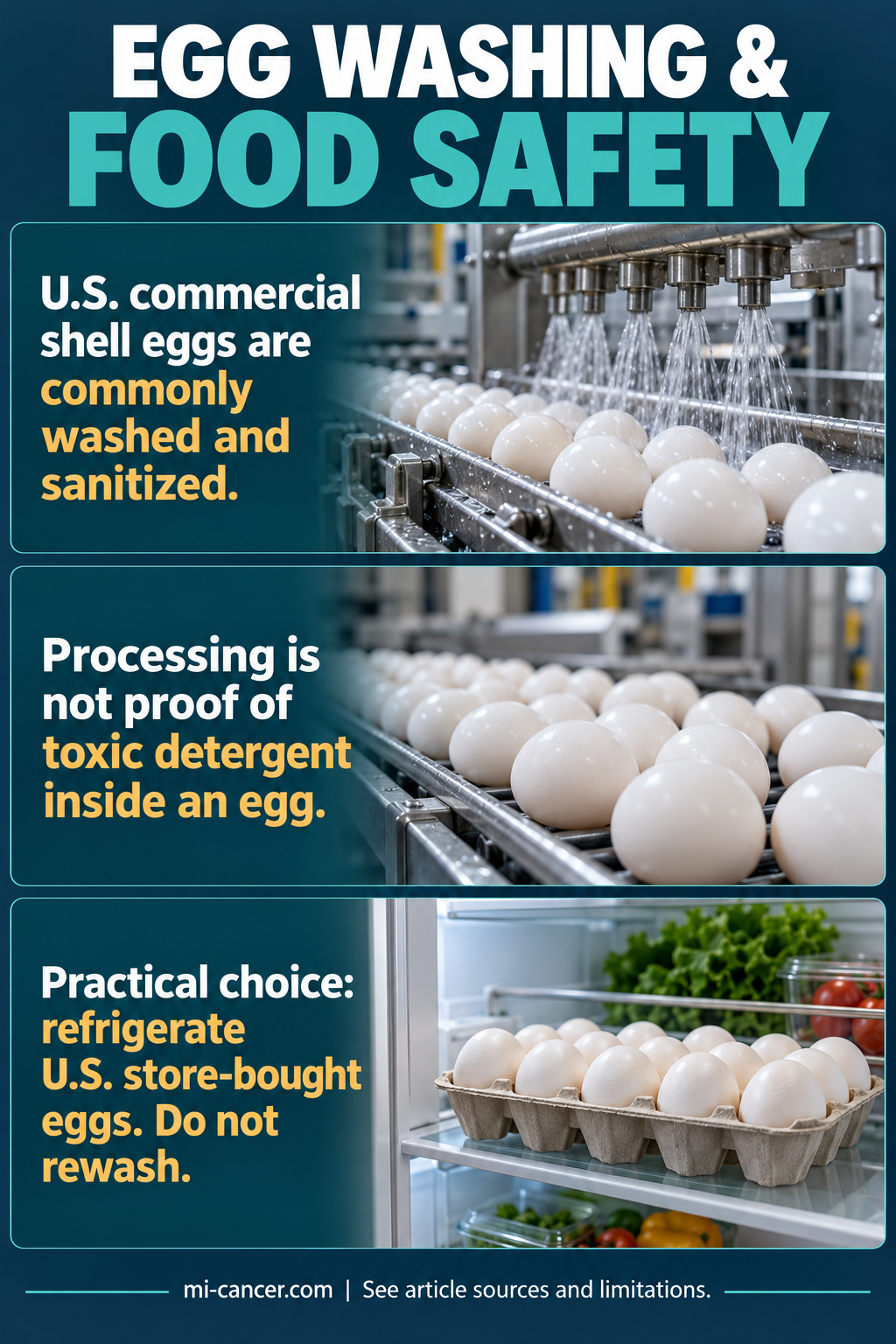
The shell has a natural protective layer. Commercial washing can remove it. USDA describes the use of a light edible mineral-oil coating to restore protection after washing. Practices vary, so a coating should not be assumed for every egg.
This is a useful awareness question: Were these eggs coated, and with what? The answer should identify the material and processing practice, rather than relying only on the words “farm fresh.”
Sources: [7] USDA FSIS: Washing food.
A processing chemical, a shell coating, and a residue inside the edible egg are different exposures. Knowing that a treatment occurred is the start of the inquiry; assessing harm requires composition, amount, and relevant evidence.
What changes when food becomes a formulation?
Preservatives, emulsifiers, sweeteners, and flavoring ingredients do different jobs. Processing can also change texture and the way a food is eaten. Evaluating a diet requires looking at both its nutritional pattern and its chemical exposures.
A 2024 review found associations between greater ultra-processed food intake and multiple adverse outcomes. Evidence certainty differed by outcome, and much of the cancer evidence was low or very low certainty. The review cannot identify a single additive as the cause.
Sources: [3] Lane et al.: Ultra-processed food exposure and adverse health outcomes.
In a controlled feeding trial, an ultra-processed diet led to greater calorie intake and weight gain than an unprocessed diet under the study conditions. This demonstrates a dietary effect, not cancer causation or proof that all processed products behave alike.
Sources: [4] Hall et al.: Ultra-processed diets and weight gain.
Processed meat is a stronger cancer finding
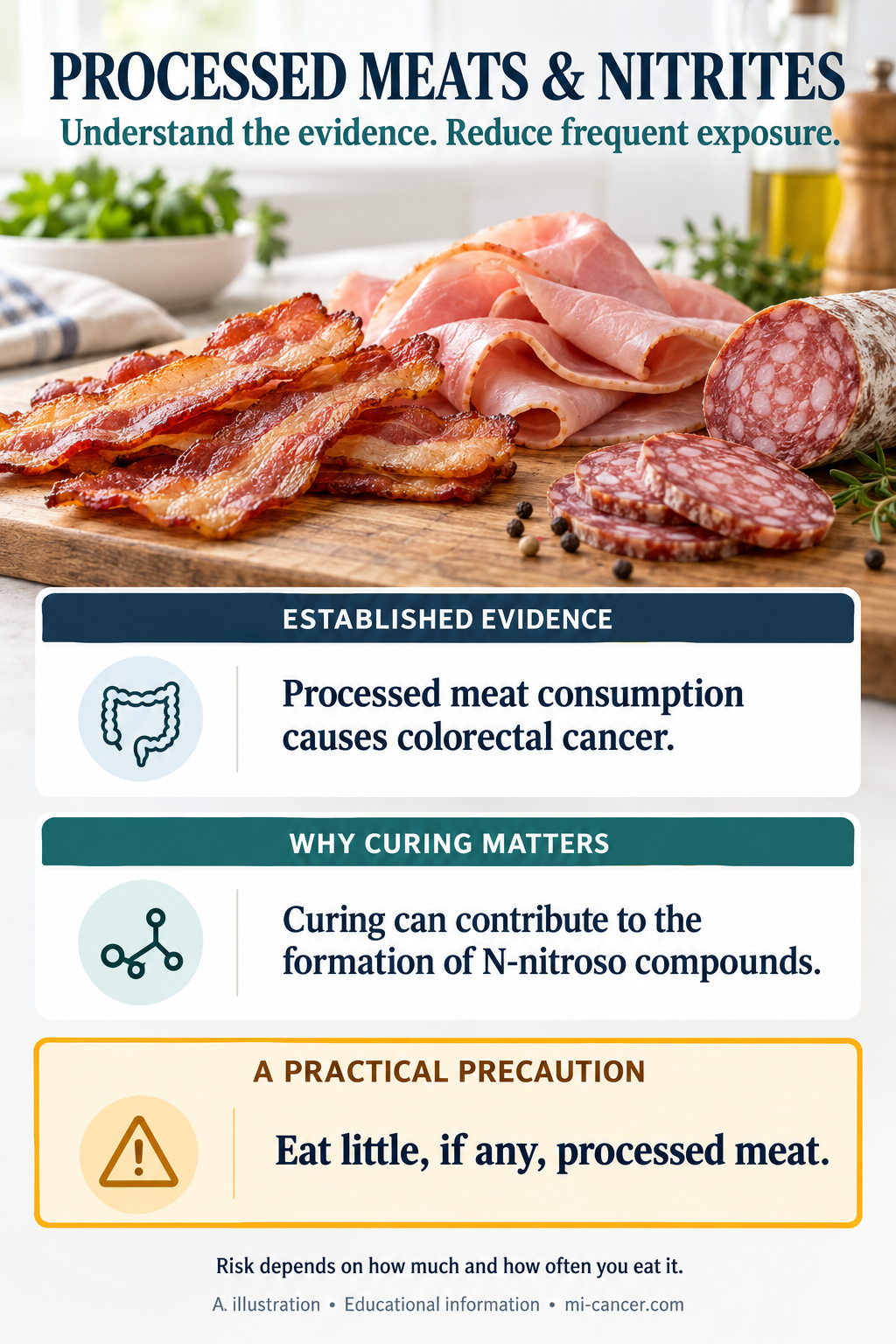
Processed meat consumption is an established cause of colorectal cancer. Curing and smoking can contribute to the formation of potentially carcinogenic compounds. Choosing little, if any, processed meat is a concrete prevention step.
“Uncured” products can contain ingredients that supply nitrate or nitrite naturally, such as celery-derived ingredients. A change in curing source does not independently establish a lower cancer risk.
Sources: [2] WHO/IARC: Red and processed meat · [26] WCRF: Evidence for cancer prevention recommendations · [28] USDA FSIS: Bacon and food safety.
Food, microbes, and the intestinal environment
Questions about the microbiome deserve direct research. They cannot be answered simply by calling an ingredient “approved” or by assuming that any change to bacteria causes cancer.
A small controlled feeding study compared an emulsifier-free diet with the same diet containing 15 grams per day of carboxymethylcellulose. Sixteen adults participated for 11 days. Researchers observed microbiome and metabolite changes. These findings justify further investigation of this ingredient; they do not prove cancer or apply automatically to every emulsifier and everyday intake level.
Sources: [11] Chassaing et al.: Controlled feeding study of carboxymethylcellulose.
Removing pathogens from milk is a different issue from changing a person's intestinal microbiome. Pasteurization reduces foodborne infection risk. The cited evidence does not establish that consuming unpasteurized milk restores the microbiome or prevents cancer.
Sources: [15] CDC: Raw milk.
Keep two questions separate: How does a diet affect the gut ecosystem? And how can a food be handled without transmitting infection? Both matter.
Farming practices matter before processing begins
Pesticide exposure
Ask about the specific crop, pesticide, application, and residue information. Agricultural workers can face different and substantially greater exposures than consumers eating food with residues.
Sources: [9] WHO: Pesticide residues in food.
A small dietary intervention found reductions in urinary biomarkers for several pesticides after participants switched to an organic diet. That supports exposure reduction for the measured chemicals. It did not demonstrate that organic food prevents cancer.
Sources: [10] Hyland et al.: Organic diet intervention and pesticide exposure.
Animal production and antibiotics
Feeding, animal housing, disease control, and medication practices are part of the food's production history. WHO recommends ending routine use of medically important antibiotics for growth promotion and disease prevention in healthy animals because of antimicrobial resistance.
Resistance is a serious health issue. It should not be confused with a claim that every meat or dairy product contains harmful antibiotic residues or causes cancer.
Sources: [14] WHO: Antibiotic use in healthy food-producing animals.
Ask about practices, not just labels
Organic certification, genetic engineering, freshness, and processing describe different aspects of a food. “Non-GMO” alone does not tell you its pesticide history, coating, or overall nutritional quality. Assessment of a genetically engineered crop does not settle the safety of every agricultural chemical used with it.
Sources: [27] NASEM: Genetically engineered crops—human health.
Chickens, pigs, cattle & farmed fish: what happened before the food reached you?
The animal's production history is part of the food's exposure history. Feed, water, veterinary treatments, and environmental contamination deserve scrutiny before meat, milk, eggs, or fish reach the store.
Separate feed ingredients, medicines, and contaminants
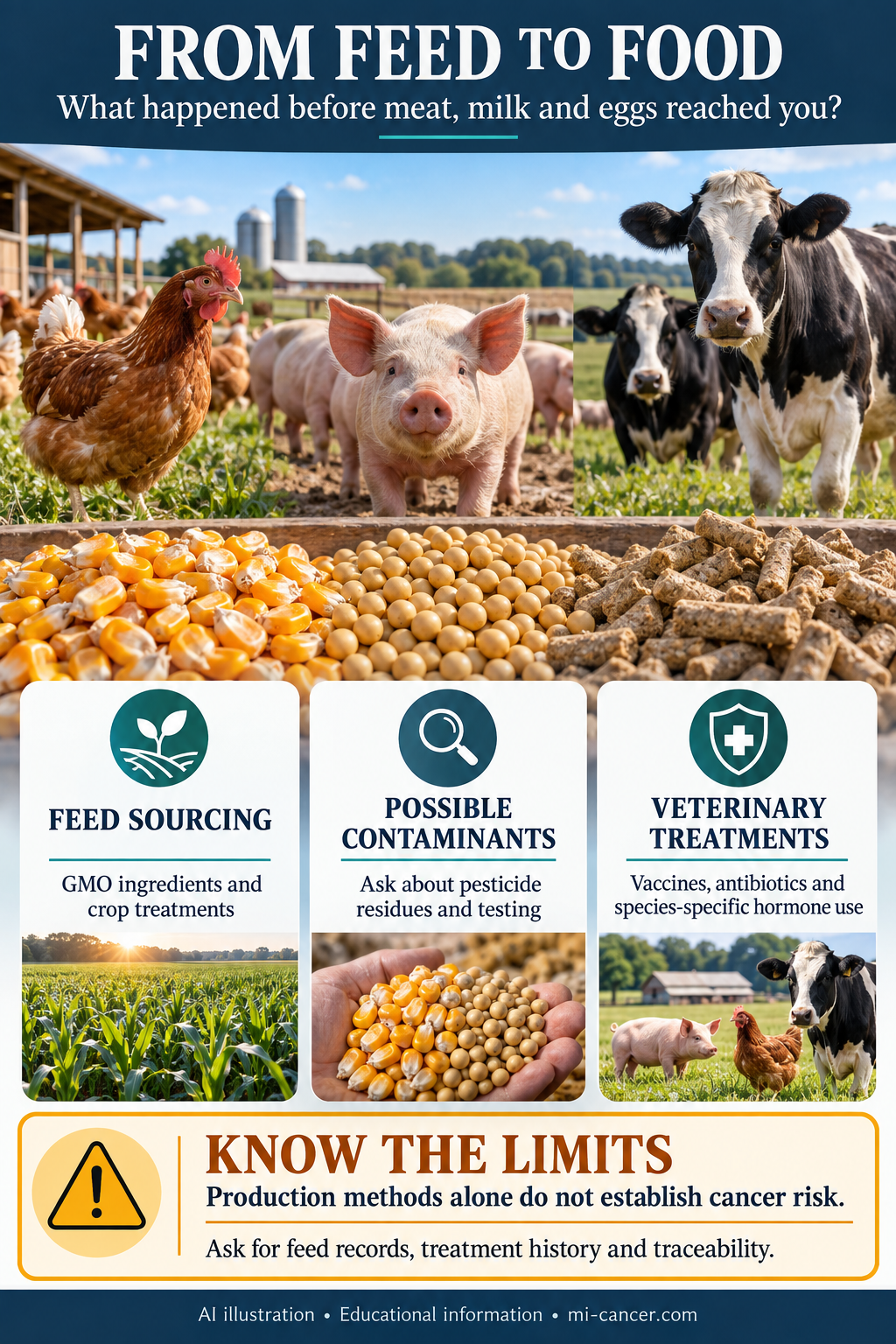
Animal feed can include grains, protein ingredients, vitamins, minerals, and other supplements. Depending on the operation, animals may also receive veterinary medicines. Feed can be unintentionally contaminated with pesticides, toxic metals, mycotoxins from mold, dioxins, or PCBs.
These categories should be named separately. “Fed with chemicals” does not tell a consumer which substance was used, whether it was a nutrient or medicine, or whether a contaminant was present.
Sources: [29] FAO/WHO: animal feed and food safety; [30] WHO: dioxins.
| Animal or product | Production questions to ask |
|---|---|
| Chickens and eggs | What feed is used? Are veterinary treatments documented? What testing addresses feed contaminants? What happens during slaughter or egg processing? |
| Pigs and pork | What are the feed sources and medication practices? Are treatment and withdrawal records available? Is the final meat fresh or subsequently cured? |
| Beef cattle | What does the feeding claim actually cover? Were growth-promoting implants or other medicines used? What residue-testing information exists? |
| Dairy cattle and milk | What feed and water quality controls are documented? How are treatments and milk-withholding periods recorded? What contamination monitoring is available? |
| Farmed fish and shrimp | Which species and farm produced it? What feed, water, medicines, and disease-control treatments were used? Are residue results and supplier records available? |
GMO feed and pesticide residues: ask two separate questions
Genetically engineered corn and soybean can be used in animal feed. Ask whether the feed contains these crops, which traits they carry, and which pesticides were used during cultivation. Herbicide tolerance and insect resistance are different traits; neither identifies the residues present in a particular feed batch.
The 2016 National Academies review included livestock feeding data and did not find evidence that the commercialized genetically engineered crops examined posed a higher human-health risk than comparable non-engineered crops. That finding does not replace pesticide testing or answer questions about every future crop, formulation, or farming practice.
Pesticides are generally crop treatments or possible contaminants, rather than nutrients deliberately added to an animal's diet. Relevant questions include the chemical identity, measured concentration in feed, possible transfer to edible tissues, and consumer exposure. A non-GMO claim alone is not proof that feed was grown without pesticides.
Sources: [35] National Academies: evidence review; [29] FAO/WHO: feed hazards; [9] WHO: pesticide residues.
Animal vaccines: document the product and its use
Vaccines may be administered to food-producing animals to prevent specific infections. They are veterinary biological products, distinct from growth hormones, antibiotics, and pesticide residues. The production history should identify the vaccine, target disease, route of administration, timing, and any applicable slaughter-withholding instructions.
Public USDA veterinary-biologics summaries provide product-specific safety and efficacy information. They can help a reader investigate what was evaluated. They do not establish what a particular farm used. Vaccinating an animal, by itself, does not establish that eating its meat, milk, or eggs causes cancer; that claim would require evidence about a specific product and dietary exposure.
Source: [36] USDA APHIS: veterinary biological product summaries.
Contaminated feed can become a food-chain problem
This is more than a theoretical question. WHO describes incidents in which dioxin contamination entered the food chain through contaminated animal feed. Some persistent contaminants accumulate in animal tissues. Transfer depends on the substance and production conditions; a feed finding cannot be converted into a consumer dose without further measurements.
Sources: [29] FAO/WHO; [30] WHO.
Antibiotic resistance and drug residues are different concerns
Antibiotic use can select resistant bacteria that spread through contact, food, or the environment. That health problem is distinct from a veterinary drug residue remaining in edible tissue. Both require evidence and controls; neither should be reduced to a generic cancer claim.
Public residue-monitoring reports cover veterinary drugs, pesticides, and environmental contaminants in meat, poultry, and egg products. A monitoring program is useful evidence to examine, not proof that every individual product was tested or that no violations occur.
Sources: [14] WHO: antibiotic-use recommendations; [31] USDA: residue data.
Growth hormones: specify the species and country
In the United States, certain steroid implants are approved for growth purposes in beef cattle. No steroid hormone implants are approved for growth purposes in pigs, poultry, dairy cows, or veal calves. Do not place chickens, pigs, beef cattle, and dairy cows under an identical “growth hormone” claim.
This describes approved uses. It does not establish the treatment history of a particular animal, assess every possible misuse, or imply that all hormonal medicines are prohibited in those species.
Source: [32] FDA: species-specific implant information.
Farmed fish: identify the farm, treatment, and residue
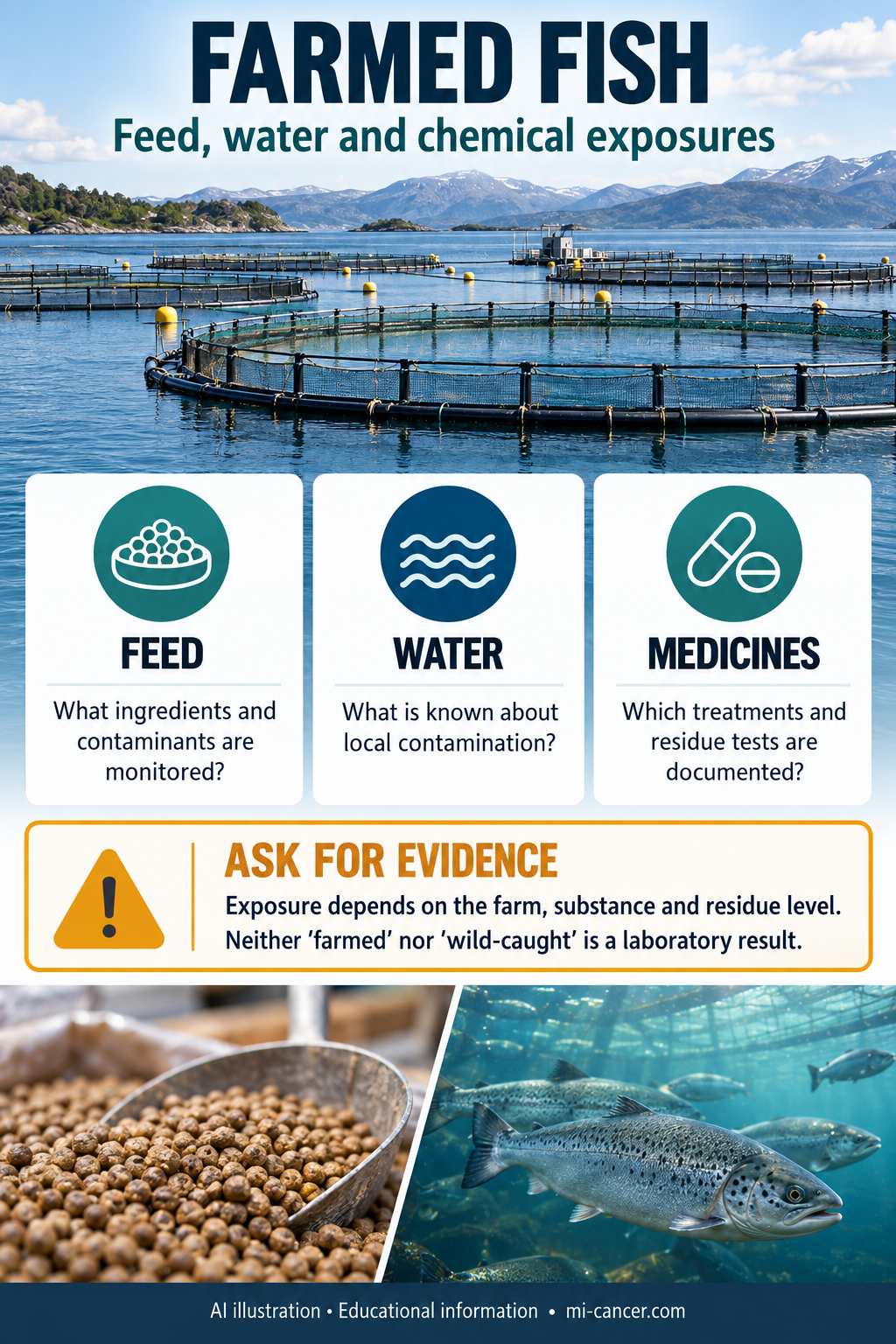
Veterinary drug residues are a recognized aquaculture hazard. Unapproved drugs or misuse of approved drugs can leave residues in edible tissue. In a 2026 letter, FDA warned aquaculture professionals that not all drugs marketed for food fish are approved.
“Farmed” alone cannot tell you which substance was used or the amount in a meal. Ask about the species, producer, treatments, and testing. “Wild-caught” alone is not a laboratory result either.
Sources: [33] FDA: aquaculture hazards; [34] 2026 letter to aquaculture professionals.
Ask for records behind the claim
Feed specifications, including GMO sourcing. Pesticide and contaminant results. Vaccine and other treatment records. Applicable withdrawal periods. Farm and supplier traceability.
A label or reassurance is less informative than evidence about the actual production system.
The container is part of the exposure story
Food-contact materials deserve attention alongside ingredients. Temperature, storage time, and the material itself can influence exposure.
Some chemicals, including certain bisphenols and phthalates, can interfere with hormone systems. Effects differ by chemical and exposure. A general label such as “plastic” cannot identify all of those differences.
Where practical, use suitable glass, porcelain, or stainless steel for food storage, especially hot foods. Do not put metal in a microwave; choose containers intended for that appliance and follow their instructions.
Sources: [12] NIEHS: Endocrine disruptors · [13] NIEHS: Bisphenol A.
These are practical exposure choices. They do not promise a complete absence of contaminants or protection from cancer.
Why cancer in younger people deserves exposure research
Increases in certain cancers among younger adults cannot be explained simply by population aging. Researchers are examining changes in environmental exposures, diet, microbial factors, and their interaction with susceptibility.
A trend is a reason to investigate. It does not identify a particular coating, additive, or food as the cause. Research needs exposure measurements, timing, biological mechanisms, and carefully designed comparisons.
Sources: [16] NCI: Why is early-onset cancer on the rise?.
Some environmental carcinogens are already established. Exposure amount and duration, as well as individual susceptibility, influence risk. DNA damage, changes in gene regulation, and hormone interference are related but distinct mechanisms; they should not all be described as “poisoning your genes.”
Sources: [17] NCI: Cancer-causing substances in the environment · [18] NCI: Epigenomics and epigenetics.
Prevention means reducing known hazards while investigating plausible ones. Improved treatment does not replace that work.
Traditional food patterns: useful context, not a miracle claim
Meals built around legumes, vegetables, whole grains, and other basic foods offer an alternative to relying heavily on industrial formulations. Modern dietary guidance supports a varied pattern centered on minimally processed foods.
Sources: [1] WHO: Healthy diet · [26] WCRF: Evidence for cancer prevention recommendations.
Regions called “Blue Zones” can be discussed as context for diet and longevity research. They are not uniform diets, and observations about a community cannot isolate the effects of coatings, pesticide exposure, or any single ingredient.
This page uses traditional food patterns as a practical reference, not a promise of exceptional longevity or evidence that earlier generations did not develop cancer.
Sources: [19] Pes et al.: Diet and longevity in the Blue Zones.
Food and environmental health share a supply chain
Agriculture and food production interact with soil, water, air, and wildlife. Pollution contributes to biodiversity loss alongside habitat destruction, climate change, overexploitation, and other pressures.
Seeing fewer insects, birds, or fish can motivate a local investigation. Establishing a cause requires environmental measurements and observations over time. A decline around one road or pier cannot by itself identify a contaminant or establish human cancer risk.
Sources: [20] WHO: Biodiversity.
Useful questions include water quality, pesticide runoff, habitat changes, and publicly available monitoring. Awareness can connect food choices with those questions without presenting speculation as a measured finding.
What consumers deserve to be able to find out
Visibility before reassurance
Consumers should be able to ask for clear ingredients, intended-use conditions, independent evidence, funding disclosures, and information about uncertainty.
- Composition: the coating, treatment, or food-contact material actually used.
- Exposure: amounts applied, measured residues, and realistic intake estimates.
- Evidence: human findings separated from animal or laboratory results.
- Transparency: who funded the research and whether independent replication exists.
- Choice: whether an untreated or differently processed option is available.
Early Apeel research received funding through the Gates Foundation's Grand Challenges program. Public grant records document that relationship. Funding can be disclosed and scrutinized, but it does not establish toxicity, ownership of every current product, or intent to harm.
Sources: [22] Grand Challenges: Molecular camouflage—developing natural barrier coatings · [23] Grand Challenges: Keeping harvested crops fresh.
A GRAS notice and a “no questions” response address a specific intended-use conclusion. They should not be described as an unconditional guarantee of zero risk.
A practical awareness checklist
Choose steps that fit your budget and nutritional needs. You do not have to replace everything at once. Selections below are temporary and reset when the page reloads.
Practical guidance: [1], [7], [13], [21], [26].
During cancer treatment: maintain adequate nutrition and follow your care team's infection-prevention guidance. Discuss major restrictions with your oncology team or a registered dietitian, especially with weight loss or reduced immunity.
Know the ingredients. Know the process. Ask for evidence. Reduce avoidable exposure.
Sources & further reading
Original research, scientific assessments, and public processing records support different parts of this article. Sources checked on October 3, 2026; this is not a claim that every source was updated that day.
- WHO: Healthy dietDietary pattern and minimally processed foods.
- WHO/IARC: Red and processed meatEstablished colorectal cancer hazard; classification is not a measure of risk size.
- Lane et al.: Ultra-processed food exposure and adverse health outcomesBMJ, 2024 · Review of epidemiological meta-analyses; certainty varies by outcome.
- Hall et al.: Ultra-processed diets and weight gainCell Metabolism, 2019 · Controlled feeding trial; not a cancer trial.
- FDA: GRN 886—Monoacylglycerides from grape seedPublic formulation-specific documentation for a produce coating.
- FDA: GRN 648 supplemental letter2024 · The older formulation was not commercialized.
- USDA FSIS: Washing foodCommercial egg washing and edible mineral-oil coating.
- USDA FSIS: Shell eggs from farm to tableRefrigeration and handling of U.S. store-bought eggs.
- WHO: Pesticide residues in foodExposure, substance-specific assessments, and occupational risks.
- Hyland et al.: Organic diet intervention and pesticide exposureEnvironmental Research, 2019 · Changes in urinary pesticide biomarkers; not cancer prevention proof.
- Chassaing et al.: Controlled feeding study of carboxymethylcelluloseGastroenterology, 2022 · Small, short human study of one emulsifier.
- NIEHS: Endocrine disruptorsHormonal effects and exposure pathways.
- NIEHS: Bisphenol AResearch and practical food-container choices.
- WHO: Antibiotic use in healthy food-producing animals2017 · Antimicrobial resistance and agricultural practices.
- CDC: Raw milkPasteurization and foodborne infection risks.
- NCI: Why is early-onset cancer on the rise?2025 · Environmental, biological, and other hypotheses under investigation.
- NCI: Cancer-causing substances in the environmentKnown carcinogens; exposure and individual susceptibility.
- NCI: Epigenomics and epigeneticsGene regulation, distinct from changes to DNA sequence.
- Pes et al.: Diet and longevity in the Blue ZonesMaturitas, 2022 · Context and limits of diet-and-longevity interpretation.
- WHO: BiodiversityPollution, habitat loss, and other environmental pressures.
- FDA: Selecting and serving produce safelyRunning-water washing; do not use household soap or disinfectants.
- Grand Challenges: Molecular camouflage—developing natural barrier coatings2012 · Public record of early Apeel research; not a description of every current formulation.
- Grand Challenges: Keeping harvested crops fresh2020 · Foundation account of initial and follow-on grant funding.
- FDA: How the GRAS notification program worksMeaning of intended-use conclusions and FDA response letters.
- NCI: Chemicals in meat cooked at high temperaturesHCA/PAH formation and limits of human dietary evidence.
- WCRF: Evidence for cancer prevention recommendationsDietary prevention context.
- NASEM: Genetically engineered crops—human health2016 · Distinguishes genetic engineering from pesticide and food-processing exposures.
- USDA FSIS: Bacon and food safetyCuring ingredients and natural nitrate-source labeling.
- FAO/WHO: Animal Feed Impact on Food SafetyExpert meeting report · Chemical hazards and transfer from feed to animal-derived food.
- WHO: Dioxins and their effects on human healthFood-chain contamination, contaminated feed, and accumulation.
- USDA FSIS: Chemical residues and contaminantsPublic monitoring information and residue datasets.
- FDA: Steroid hormone implants used for growth in food-producing animalsSpecies-specific approved uses in the United States.
- FDA: Aquacultured seafoodDrug residues as a food-safety hazard; supplier and testing context.
- FDA: Letter to aquaculture professionals2026 · Warning about unapproved drugs marketed for food fish.
- National Academies: Genetically Engineered Crops—Summary2016 · Crop traits, livestock feeding evidence, and limits of broad claims.
- USDA APHIS: Veterinary biological product summariesPublic product-specific safety and efficacy summaries, including animal vaccines.
Educational & editorial notice
This page provides general education through original summaries of public sources. It does not test a product, diagnose an exposure, or determine the cause of an individual's cancer. Scientific findings apply to the substances and conditions studied.
The three photographic figures are AI-generated illustrations, not photographs of products tested by mi-cancer.com. Their captions and the article explain the evidence and limitations.
Practices differ by producer and region. Historical comparisons are illustrative, not measurements of every community. Submit proposed corrections through the website's existing contact channel with a verifiable source.